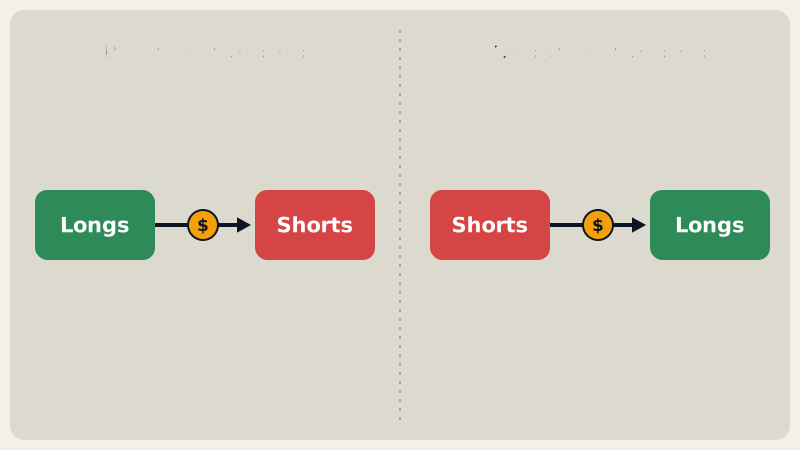
The funding rate is a periodic payment exchanged between traders holding long and short positions in perpetual futures. It exists to keep the perpetual contract's price close to the spot price. When the rate is positive, longs pay shorts; when it is negative, shorts pay longs. The exchange itself does not collect it.
What is a perpetual future, and why does funding exist?
A normal futures contract has an expiry date. At expiry its price is forced to meet the spot price. A perpetual future has no expiry, so nothing forces that meeting. Without a mechanism, the perpetual could drift far above or below spot for as long as one side was more eager than the other.
Funding is that mechanism. It is a cost that rises as the perpetual trades further from spot:
- If the perpetual trades above spot, longs are eager. Funding turns positive: longs pay shorts. Holding a long gets more expensive and holding a short gets rewarded, which nudges price back toward spot.
- If the perpetual trades below spot, shorts are eager. Funding turns negative: shorts pay longs.
Two details people often miss:
- It is peer to peer. The payment goes from one side of the market to the other, not to the exchange.
- It only counts at settlement. On Binance most contracts settle every 8 hours (00:00, 08:00 and 16:00 UTC), and some contracts settle more often. If you close before the timestamp, you pay or receive nothing for that period. The amount is your position's notional value times the rate.
What is a normal funding rate, and what is extreme?
Rates are quoted per funding period, usually 8 hours. A commonly used baseline is about 0.01% per 8 hours, a slightly positive default that reflects the cost of borrowing in the market. Calm conditions tend to sit near it, and exact settings vary by exchange and contract.
That baseline matters for how you read the number:
- Around +0.01% is ordinary. It does not mean longs are crowded.
- Well above it, for example several times the baseline, means longs are paying up noticeably.
- Below zero is notable precisely because the default is slightly positive: shorts are paying, which is not the usual state.
Here is a hypothetical to feel the cost. Say funding is +0.03% per 8 hours. That is three payments a day, so about 0.09% of your position's notional per day. At 10x leverage, that is roughly 0.9% of your margin per day, just for holding. That is what makes holding a crowded long uncomfortable: you pay to wait.
There is no reliable table of "typical extremes" to quote, because limits differ by contract and market regime. Compare the current number with that coin's own recent history instead.
What can an extreme funding rate tell you?
- Crowding. Many traders are on one side and are willing to pay to stay there.
- Carrying cost. The longer funding stays extreme, the more it costs the crowded side to wait for the move.
- Fuel for a flush or squeeze. If price stalls, crowded traders are the ones forced out first. A crowded long is a candidate for a long flush (a fast drop that liquidates longs). A crowded short is a candidate for a short squeeze.
What can't an extreme funding rate tell you?
- When. Funding can stay elevated for days or weeks inside a strong trend. "Funding is high, so it must fall" has stopped many traders out of a good move.
- Direction. High positive funding is not a bearish call and high negative funding is not a bullish one. It describes who is paying, not who is right.
- Who is smart money. Funding is an aggregate. It cannot show you whose positions are large or well informed.
- Anything about other exchanges. One exchange's rate is one slice of the market.
So treat funding as a pressure gauge on the side of the trade, not as a trade by itself.
How do funding, long/short ratio and taker flow fit together?
Funding is one of three views of the same crowd:
- Funding rate: the price of holding a position. High positive funding means longs are paying.
- Long/short ratio: how many accounts (or how much positioning) are long compared with short, depending on how the data provider counts it.
- Taker buy/sell ratio: whether aggressive market orders in recent trading were mostly buys or sells. Takers cross the spread to get filled now.
When two or three agree, the picture is stronger. High funding with a lopsided long/short ratio and heavy taker buying says longs are crowded and still pushing. High funding with a modest long/short ratio and light taker buying is a weaker case: the cost of carrying is up, but the crowd is not obviously lopsided.
Also watch open interest. A crowd matters more when it is large and growing than when positions are being closed.
What does it look like on real charts?
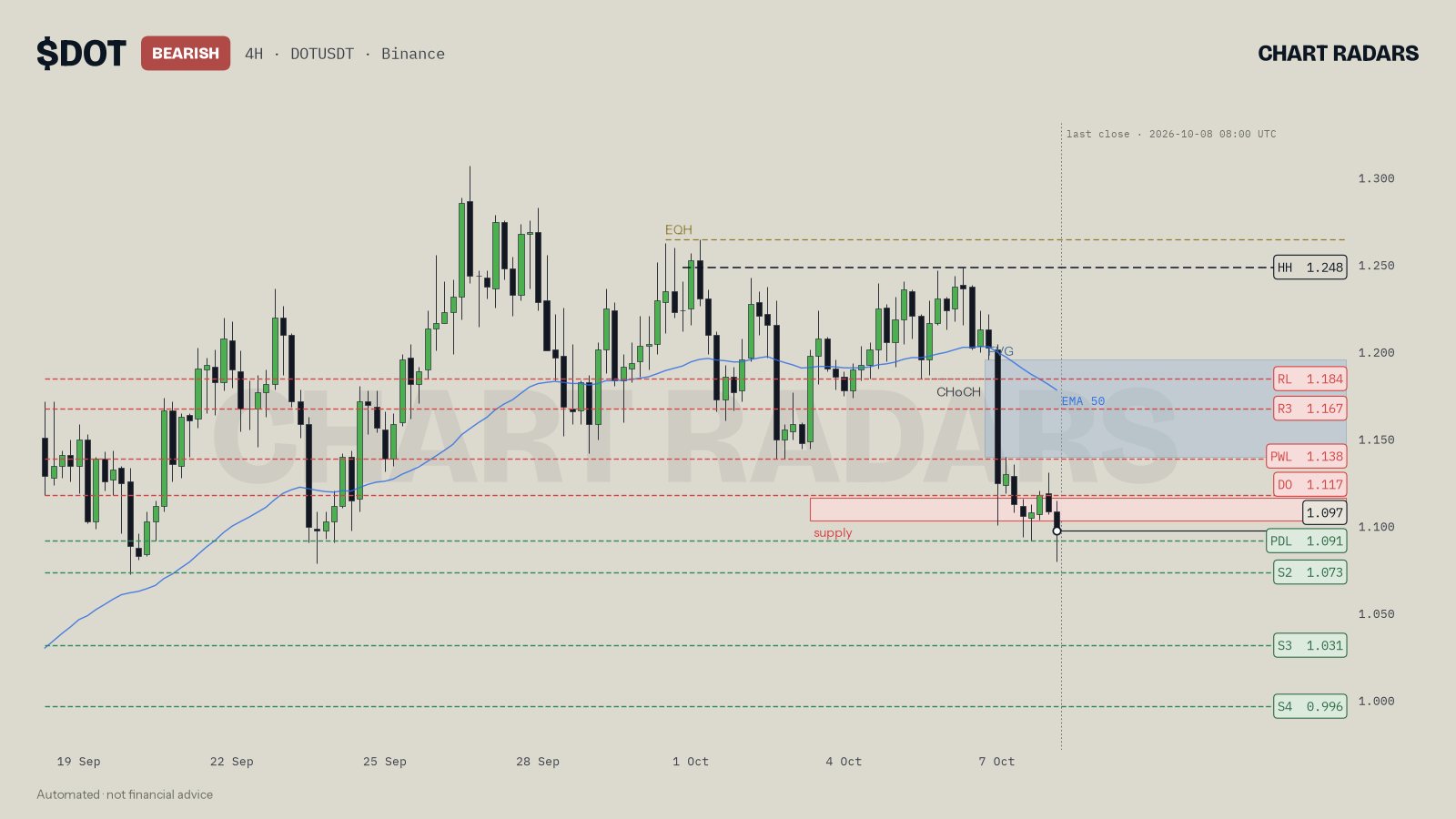
DOT 4H, 8 Oct 2026. The structure is bearish on 4H, 1D and 1W, a CHoCH down is on the chart, and price at 1.097 sits under the daily open at 1.117. The flow line of the read shows funding +0.0100%, long/short 1.64 and takers 0.98x, and the read states that longs look crowded in the flow data, leaving room for a flush toward 1.103. So the crowding observation supports a plan that is already based on structure: a bounce into the 1.103–1.115 supply zone, invalidation above 1.248, and a wait for lower-timeframe confirmation. Funding did not create the idea; it adds a reason to be patient with longs.
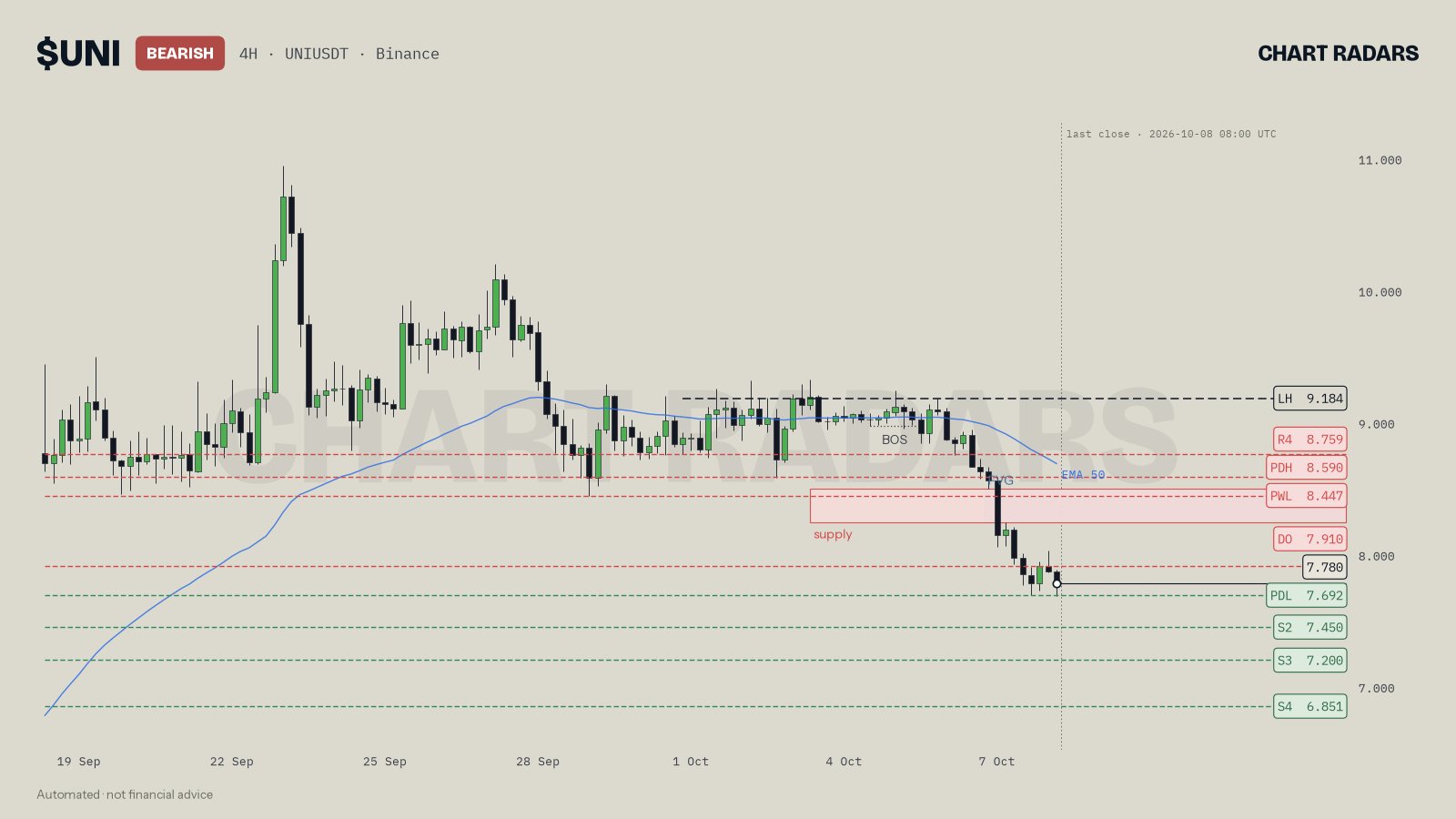
UNI 4H, 8 Oct 2026. Same funding figure, +0.0100%, but a different picture: long/short is 1.42 and takers are 0.92x, and the read does not flag the long side as crowded. The same number on two coins means different things when the other two measures disagree. Notice also that the read says the move down is not being fed by new leverage, with open interest down 8.8% on the day. The structure carries this read: bearish on 4H and 1D, a preferred short zone at 8.247–8.500 and invalidation above 9.184.
How do you use funding in a conditional plan?
Use it as a filter on ideas that structure already suggests, with if/then statements:
- If structure is bearish, price rallies into a premium supply zone, and funding is high with crowded longs, then a rejection there has more fuel behind it. Invalidation stays above the last lower high.
- If structure is bullish and price pulls back while funding resets toward its baseline, then the pullback is cleaner: weaker hands have already paid or left, and you are not entering into a crowd.
- If price sweeps a low and funding is negative, then a reclaim of that low has short-squeeze fuel. The trigger is the reclaim, not the funding number.
- If funding is extreme but structure is intact and trending, then do not fade it just because of funding. Wait for a structure break (see liquidity sweeps for one common trigger).
When does funding mislead you?
- Calling a top or bottom from one number. Extreme funding is a condition, not a timing tool.
- Comparing coins directly. Each coin has its own normal range. Compare each coin with its own history.
- Ignoring the interval. A contract that settles every 4 hours or hourly shows smaller numbers per period for the same pressure. Check what period the number refers to.
- Forgetting the lag. Funding reflects how the perpetual traded relative to spot over the recent past. It will not warn you at the moment a trend turns.
- Treating one exchange as the market. Positioning can differ between venues.
In Chart Radars: funding is the Binance perpetual rate per 8 hours, shown in percent. The engine treats above 0.03% as longs paying noticeably and below -0.01% as shorts paying. The "crowded long" flag needs the long/short ratio at 1.5 or more and either taker buy/sell at 1.2 or more or funding at 0.01% or more. For altcoins, a long/short ratio above 2 on its own is considered normal. None of these rules predicts direction; they describe crowding.
Honest note: funding is often sold as a contrarian trigger: "everyone is long, so short it". That is too neat. Crowded trades can stay crowded for a long time, and positioning data is noisy. Chart Radars uses funding as one line of context next to structure, zones and invalidation, and our own backtest found that even the trend label alone gave no strong directional edge, so a single derivatives number should not be asked to do more.
Key takeaways
- Funding is a payment between longs and shorts, set up to keep a perpetual contract near spot; positive means longs pay, negative means shorts pay.
- Around +0.01% per 8 hours is a common baseline, so ordinary readings do not mean crowding.
- Extreme funding tells you about crowding and carrying cost, not about timing or direction.
- Confirm crowding with long/short ratio, taker flow and open interest before leaning on it.
- Use funding as a filter on a structure-based plan, with a clear invalidation, never as a trade by itself.
Frequently asked questions
What is the funding rate in crypto?
It is a periodic payment between traders holding long and short perpetual futures positions. It exists to keep the perpetual price close to the spot price.
Do you pay funding if the rate is positive and you are long?
Yes. With a positive rate, longs pay shorts, but only if you hold the position at the moment funding is settled. Binance settles every 8 hours on most contracts.
Is a high funding rate bearish?
Not by itself. It shows longs are crowded and paying a cost, which makes a sharp flush more likely if price stalls, but funding can stay high for a long time in a strong trend.
What does negative funding mean?
Shorts are paying longs because the perpetual trades below spot. It points to bearish crowding, and it can fuel a short squeeze, but it also appears in plain downtrends.
What is a normal funding rate?
A common baseline is around 0.01% per 8 hours, so readings near that are ordinary. Values several times higher, or below zero, are worth a look, but limits differ by contract.