BOS stands for break of structure and CHoCH for change of character. Both describe a candle closing beyond the last confirmed swing point. A BOS breaks in the same direction as the previous break, so it continues the trend. A CHoCH breaks the opposite way, which makes it the first sign that the old structure may be weakening.
The two terms look like jargon, but they answer a simple question: did price just confirm what it was already doing, or did it do something it had not done before? Getting this right keeps you from calling every small move a "reversal" and from ignoring the first real warning. This guide covers the exact rules, the close-versus-wick trap, a worked example on real charts, and how to plan around a break without treating it as a prediction.
What is a break of structure (BOS)?
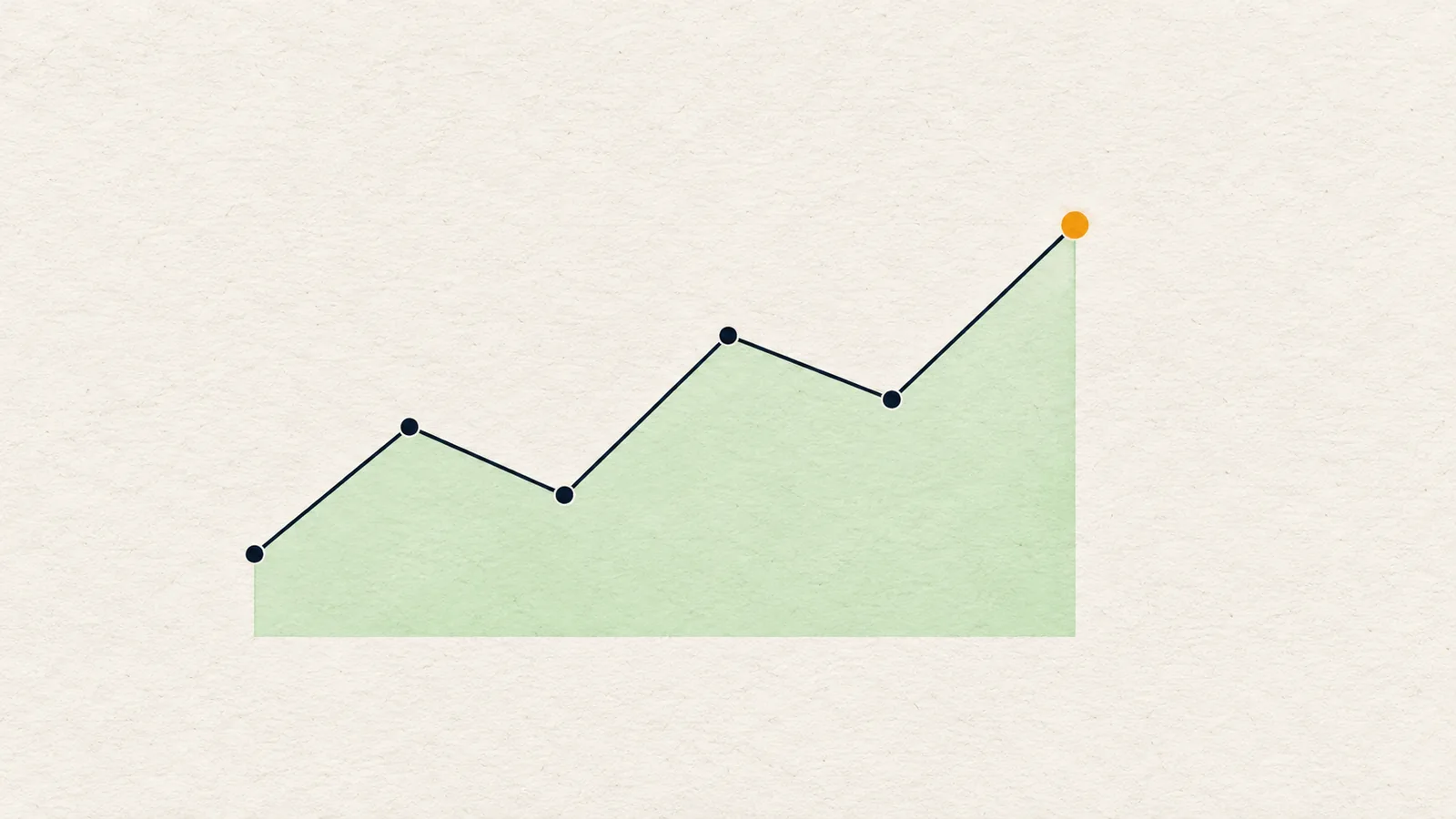
Start from market structure: a trend is a staircase of swing points. In an uptrend, price makes a higher high, pulls back to a higher low, then pushes through the last swing high again. That push, a close above the previous swing high, is a BOS. The same logic applies downward: in a downtrend, a close below the last swing low in the direction of the move is a bearish BOS.
A BOS is a confirmation. It says the move that was already in place has taken out the next swing and is still working. It is not an entry on its own, and it is not a promise of more. It is a tick mark that the structure is intact.
What is a change of character (CHoCH)?
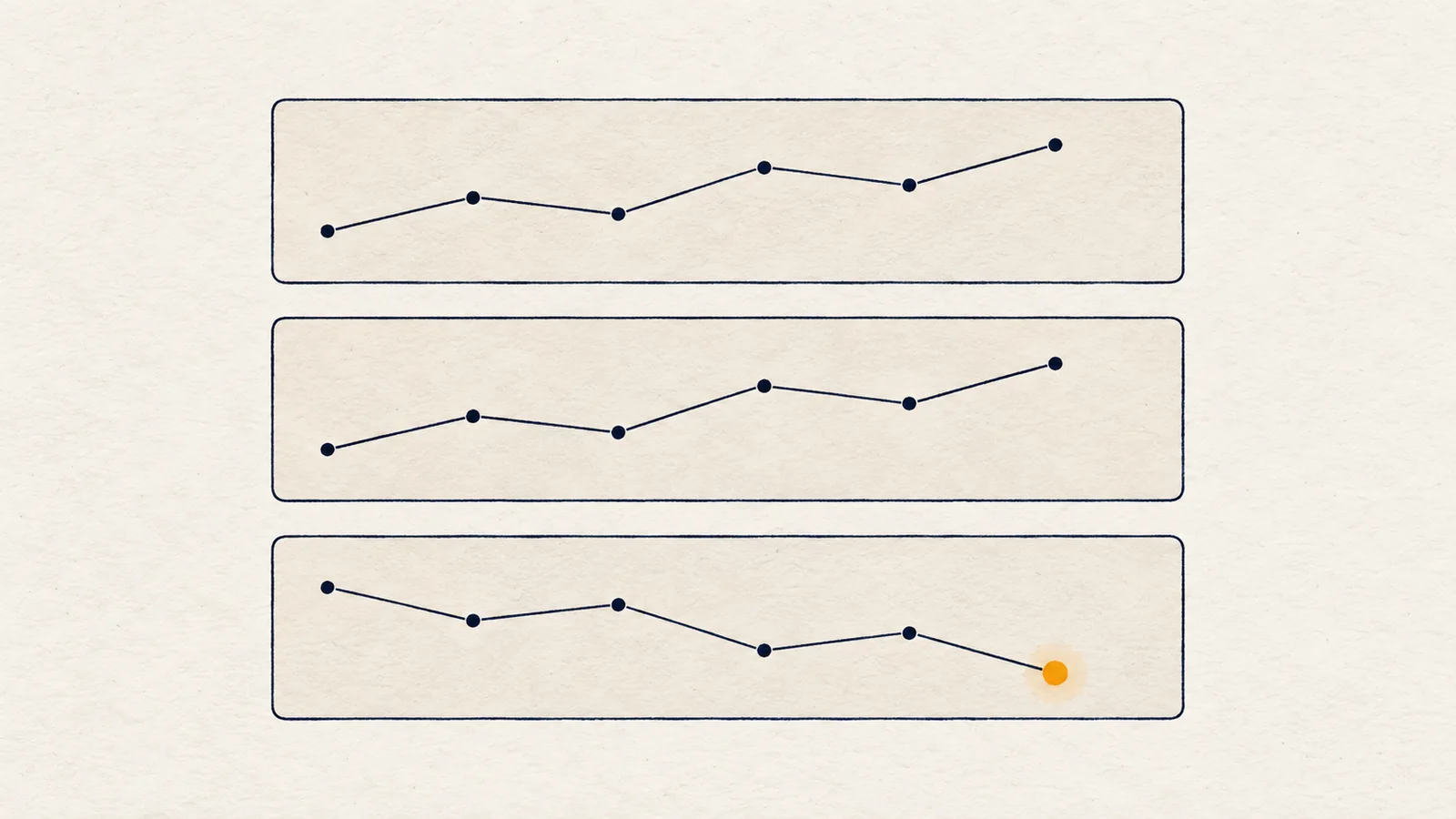
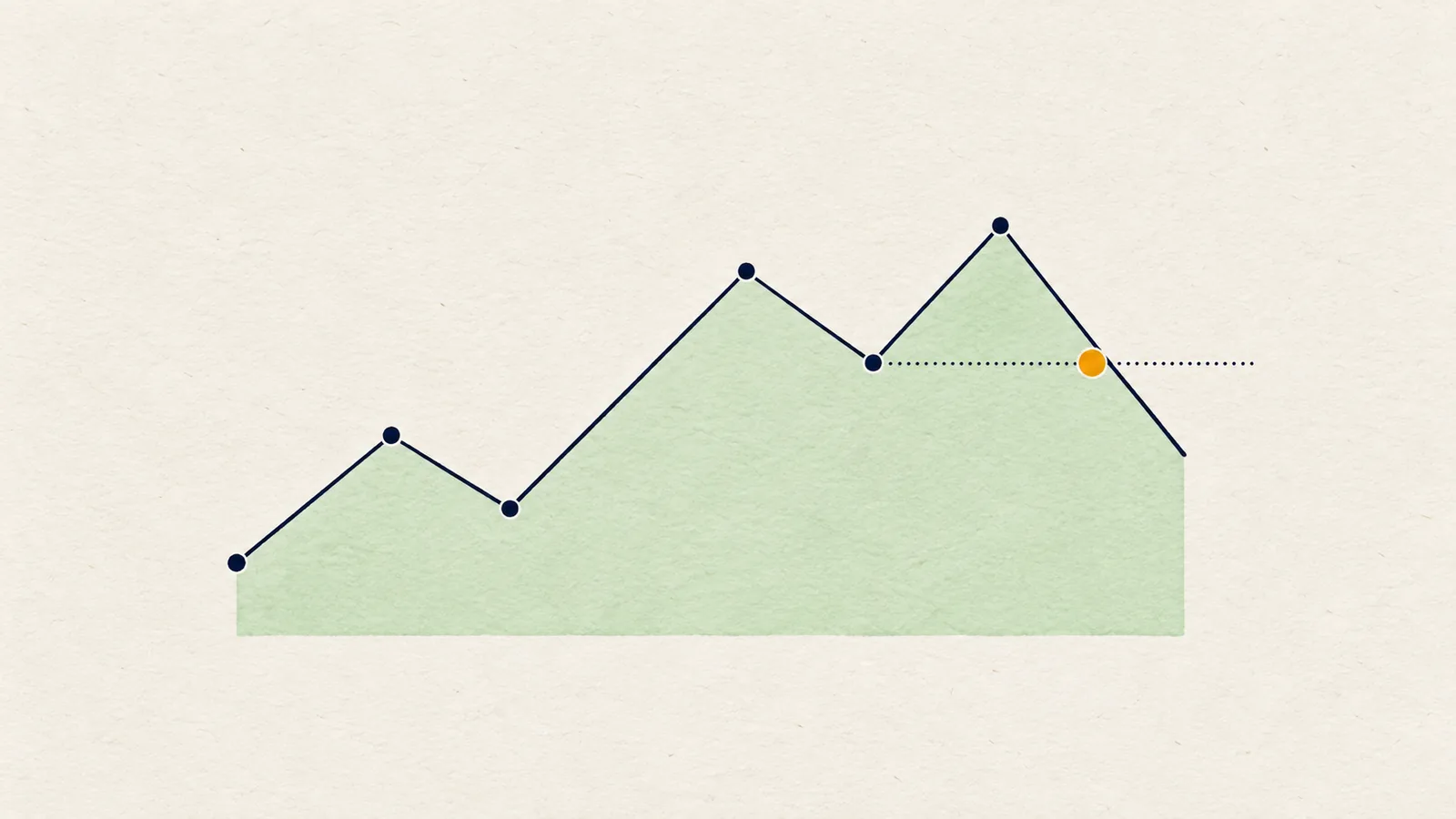
A CHoCH is a close beyond a swing in the direction opposite to the previous break. Picture a downtrend that has been making lower lows and breaking swing lows. If price suddenly closes above the last lower high, the market has done something it had not done during the whole move down: it broke a swing in the other direction. That is the change of character.
The word "character" is useful. Every market has a personality at a given time. In a downtrend the personality is "rallies fail". A CHoCH says a rally did not fail, at least once.
How are BOS and CHoCH different?
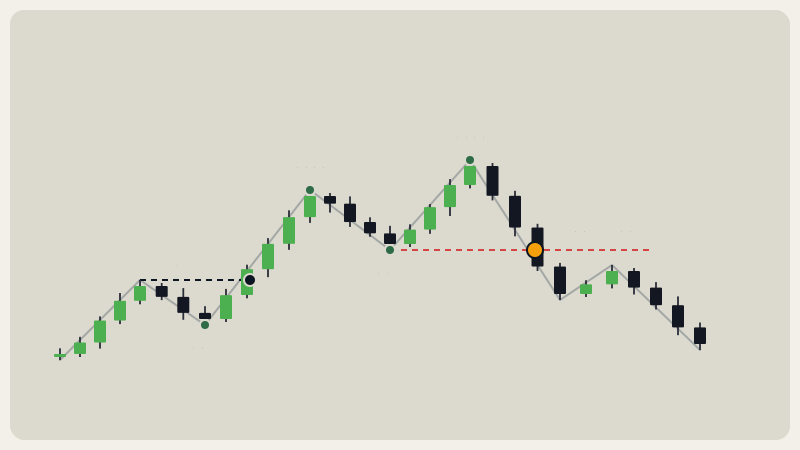
The only thing separating them is direction compared with the previous break:
| BOS | CHoCH | |
|---|---|---|
| Direction vs previous break | Same | Opposite |
| What it says | Trend is continuing | Trend is being questioned |
| Typical role | Confirmation | Early warning |
| What it does not say | That more is coming | That a reversal is underway |
Most of the confusion comes from people memorising a picture instead of the rule. If you can answer "what direction was the last break, and what direction is this one?", you can classify any break without a chart.
Should the break be a close or a wick?
A close. This is the single most important rule and the most common mistake.
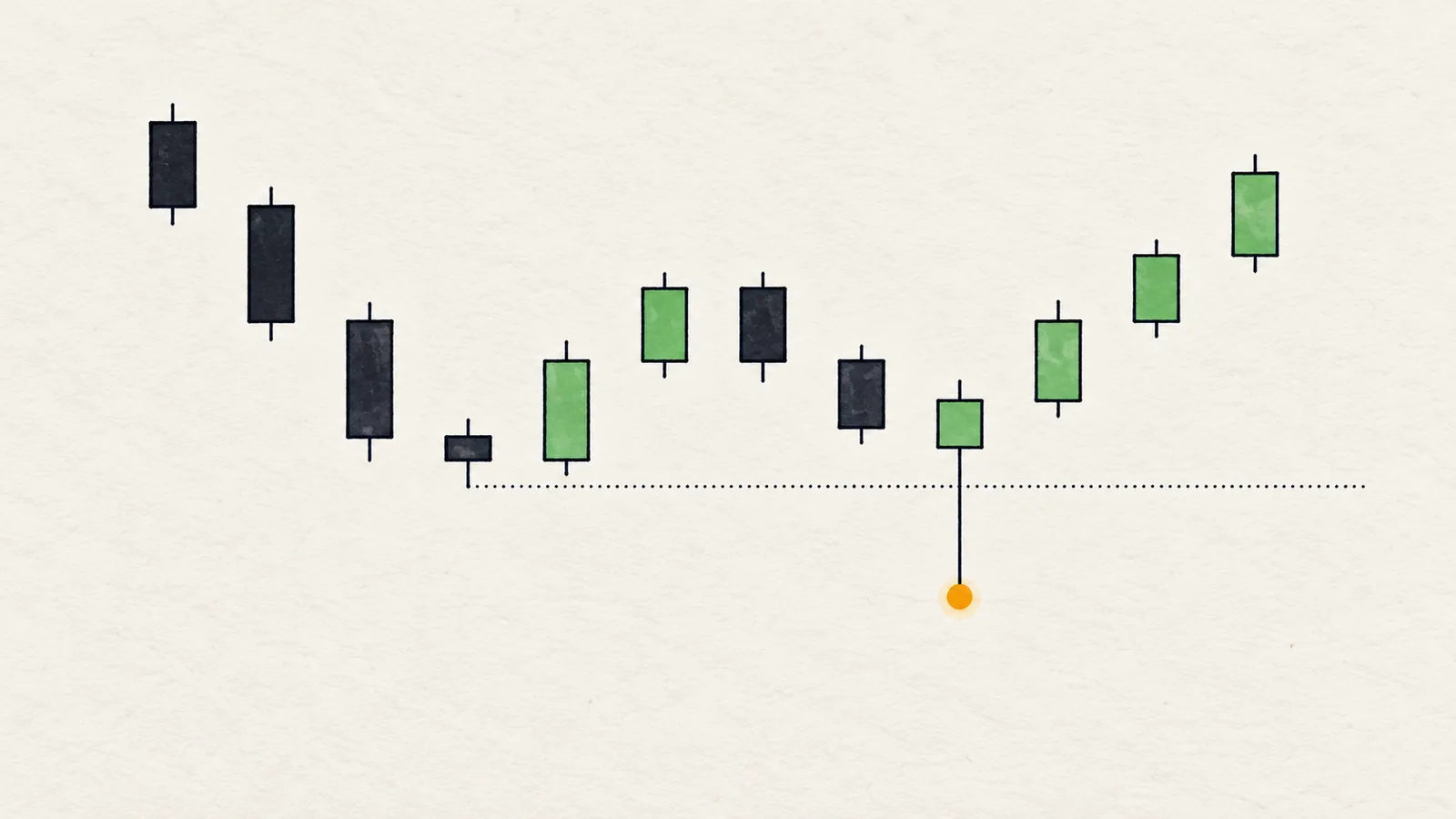
If price pokes a wick through a swing high but the candle closes back below it, the swing was not broken, it was tested and rejected. When a wick takes out stops resting beyond a level and the candle then closes back inside, that is a liquidity sweep. A candle body that closes beyond the level is a break.
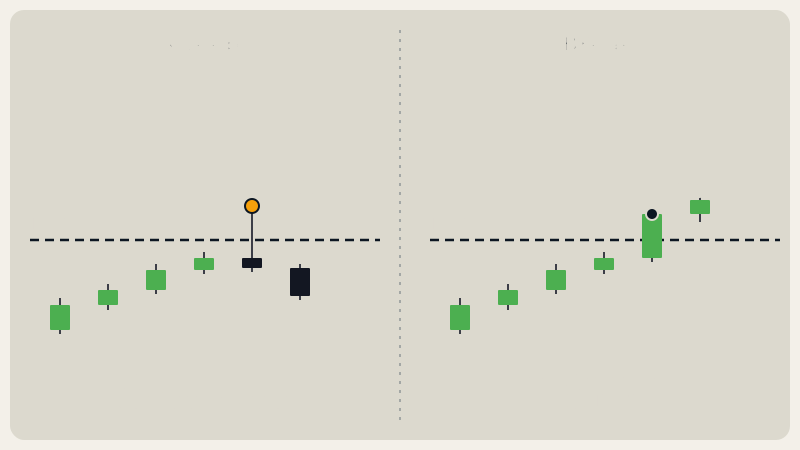
Why does the difference matter? A close shows that price was accepted beyond the level at the end of a full candle. A wick only shows it was visited. For more on the wick case, read liquidity sweeps.
Tip: On the timeframe you trade, wait for the candle to close before you label a break. A candle that is still open can finish as either a sweep or a break.
How do you spot a BOS or CHoCH, step by step?
- Mark confirmed swings on your timeframe (see the market structure guide).
- Note the last break: which direction was the most recent close beyond a swing?
- Pick the swing price is now pushing against. In an uptrend, it is the last swing high. In a downtrend, the last swing low.
- Wait for a candle close beyond it. A wick does not count.
- Compare directions. Same as the previous break? BOS. Opposite? CHoCH.
- Draw the broken level and keep it on the chart. Retests of that level are where most of the useful decisions happen.
Each swing breaks only once. After a close beyond a swing, that swing is used up: you need the next swing for the next break.
Why is a CHoCH an early warning and not a reversal?
Because a CHoCH only proves one thing: one swing was broken against the trend. It does not prove that:
- the next swing will also break,
- buyers or sellers have taken control,
- the former trend is over.
After a CHoCH, three outcomes are common. Price can build a new opposite trend, with a clear BOS following the CHoCH. Price can drift into a range between the old high and the new low. Or price can reclaim the broken level and carry on in the old direction, which leaves the CHoCH as a false alarm.
The way to tell which is unfolding is to keep watching structure after the break: does the next pullback hold above the last low, and does the next push break another swing in the new direction? One CHoCH is a hypothesis. A CHoCH followed by a BOS in the same direction is a stronger case.
Timeframe also matters. A CHoCH on a 1-hour chart inside a strong daily trend is a weaker warning than a CHoCH on the daily itself. See multi-timeframe analysis for how to weigh them.
How do you use BOS and CHoCH in a plan?
Use them to switch between plans, never to predict.
- After a BOS in your direction: the trend is intact. The if/then is "if price pulls back to the broken level or a nearby zone and holds, I look for continuation; if it closes back below the swing that protects the move, the idea is void."
- After a CHoCH against your direction: stop adding to the old idea. The if/then is "if price retests the broken level and fails to reclaim it, the warning is confirmed; if it closes back through, the CHoCH was a false alarm."
- At the same time, define the invalidation. Every break comes with a swing whose loss cancels the plan. Write that price down before you act.
What do BOS and CHoCH look like on real charts?
A CHoCH while the bigger picture disagrees: BTC 4H, 8 Oct 2026
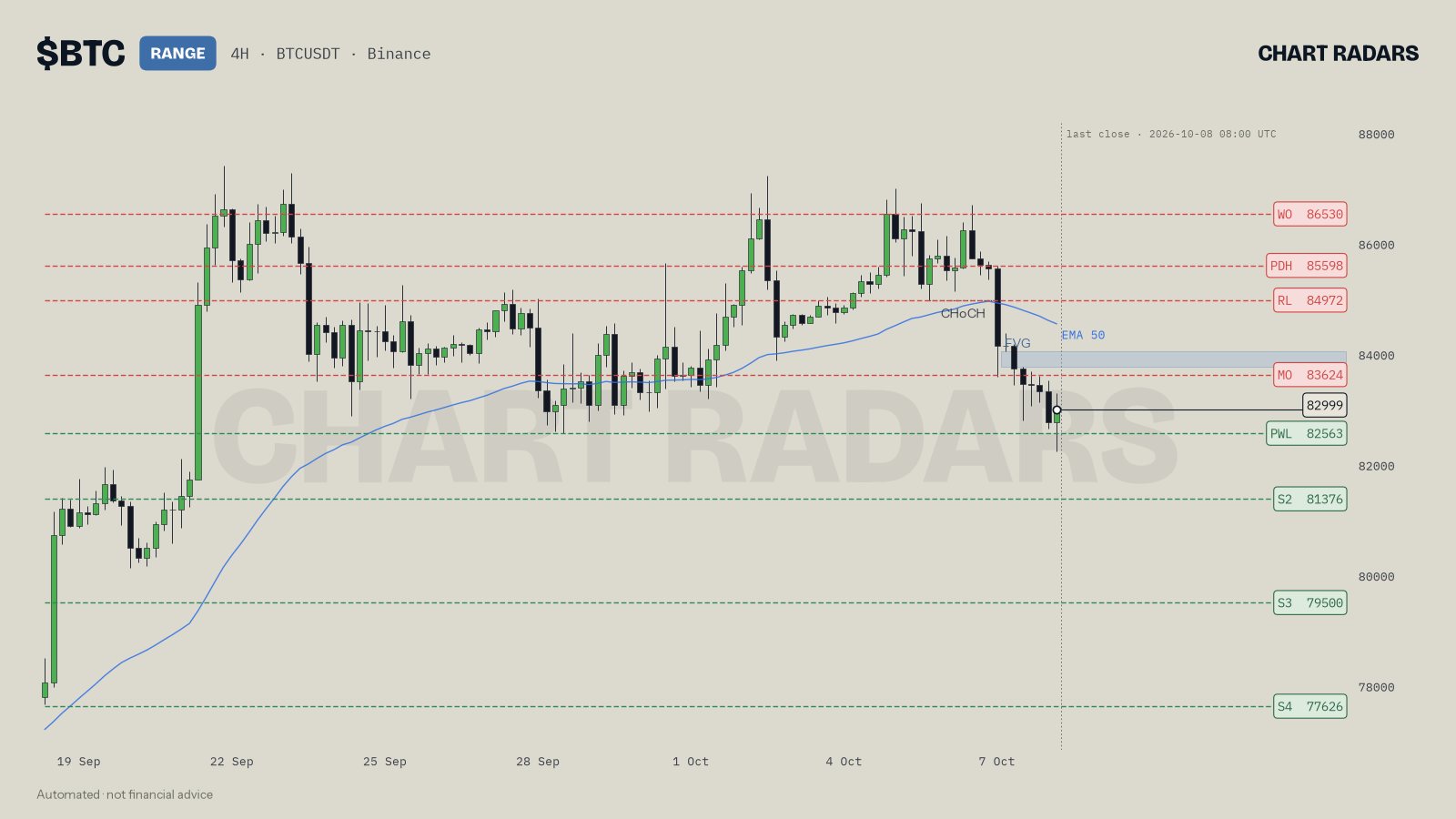
On this chart the last structure break is a CHoCH to the downside through 84972, labelled on the chart. The chart label is RANGE, which is how the chart shows a neutral bias: the read has 4H bearish while 1D and 1W are bullish, and the 4H structure itself is mixed (lower highs but higher lows). With the timeframes in conflict the overall bias is neutral, and the plan is to act only at the edges of the 82563 to 83624 area. This is the right way to treat a CHoCH: as a flag that the 4H structure has changed character, not as a verdict that Bitcoin has reversed.
A BOS inside a downtrend: SOL 4H, 8 Oct 2026
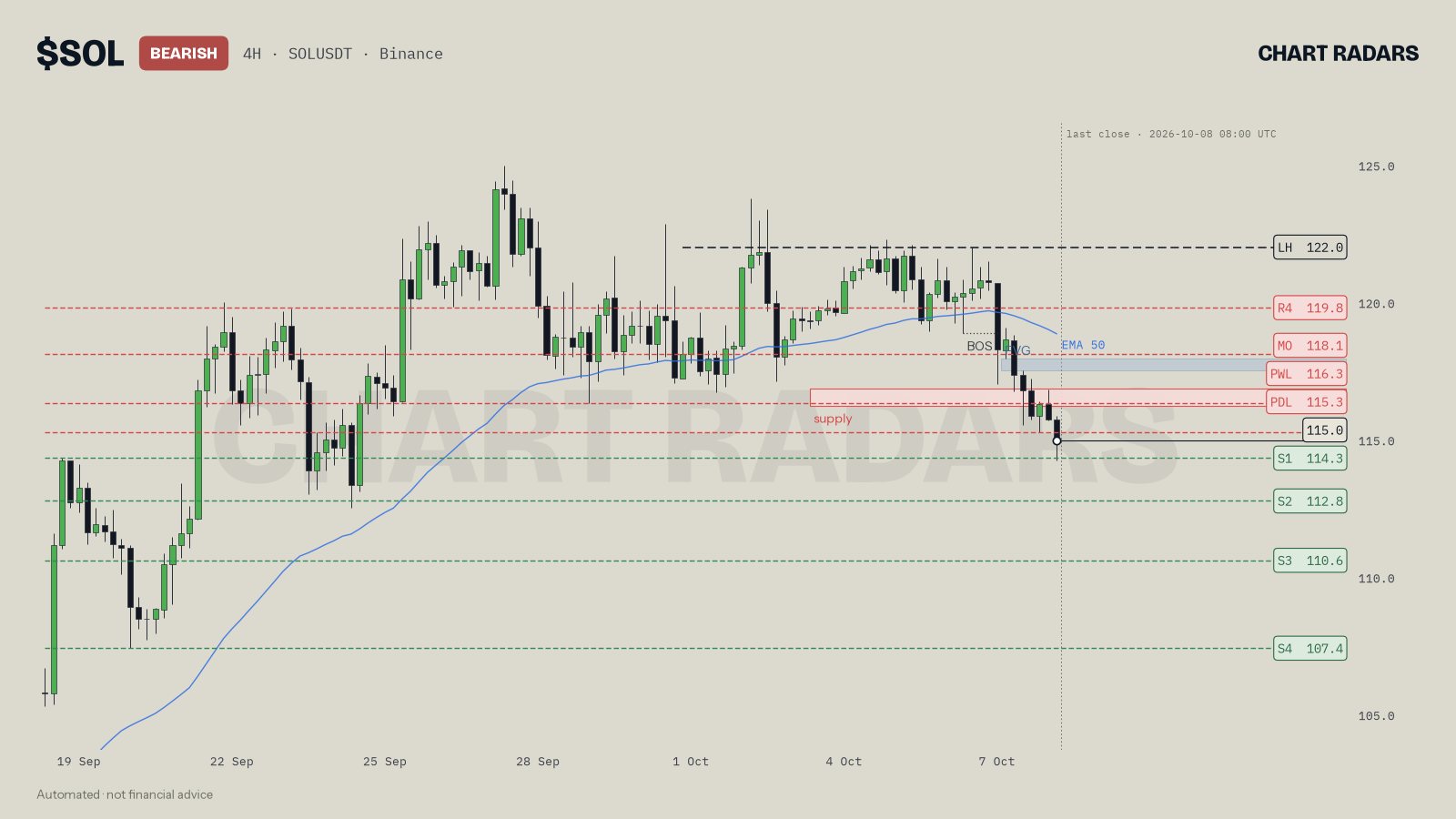
Here the last break is a BOS to the downside through 118.88, in the same direction as the previous break, and the 4H structure is a lower high with a lower low. Price sits at 115.0. The read is bearish and lists 122.0, the last lower high, as the level whose 4H close would end the idea. The weekly structure is still bullish, so the read keeps size smaller. A BOS here says the move is working on this timeframe, nothing more.
In Chart Radars: A structure break is a candle close beyond the last confirmed swing high or low (a swing is confirmed with three candles on each side). A break in the same direction as the previous break is labelled BOS, one in the opposite direction CHoCH. Each swing can be broken only once, by its first close beyond it. Breaks are searched for within the last 60 candles, and the chart shows the latest one. A wick that goes through a recent swing (within the last 40 candles) during the last 3 candles but closes back inside is counted as a sweep, not a break.
When do BOS and CHoCH mislead?
Inside a range. In choppy markets, breaks come and go in both directions. You get a CHoCH followed by a BOS followed by another CHoCH, and none of it is information. When the market is a range, treat the edges as the story and not the labels.
Against a stronger timeframe. A bearish CHoCH on a low timeframe in a strong higher-timeframe uptrend is often just a pullback.
On thin or news-driven candles. A close beyond a swing during a spike in volatility can reverse within a few candles.
When you count wicks as breaks. This is the most common source of false labels, and the reason this guide keeps repeating the word "close".
Honest note: A CHoCH is an early warning, not a reversal guarantee. It tells you the old structure has been damaged. Sometimes it is the first step of a real trend change and sometimes price takes the level back within a few candles. Chart Radars treats it the same way: as a condition on the map, which is why the read stays conditional after one.
Key takeaways
- A break of structure is a candle close beyond a confirmed swing high or low; a wick is not enough.
- BOS means the break is in the same direction as the previous break (continuation). CHoCH means the opposite direction (first sign of change).
- A CHoCH is an early warning, not a reversal. Keep reading structure after it: the next swing decides more than the break did.
- Use breaks to switch between if/then plans and always write down the swing whose loss cancels the plan.
- Weigh breaks by timeframe: a break against a stronger timeframe deserves more doubt.
Frequently asked questions
What is the difference between BOS and CHoCH?
Both are closes beyond a confirmed swing point. A BOS breaks in the same direction as the previous break, so it continues the trend. A CHoCH breaks in the opposite direction, so it is the first sign the trend may be changing.
Does a CHoCH mean the trend has reversed?
No. A CHoCH is an early warning that the old structure has been damaged. Price can stall, range or resume the old direction afterwards, so it needs to be handled as a condition, not a reversal call.
Should a break of structure be a wick or a candle close?
A candle close beyond the swing. A wick that pokes through and closes back inside is a liquidity sweep, which is a different event with a different meaning.
What does BOS mean in crypto trading?
BOS stands for break of structure: price closes beyond the last confirmed swing high or swing low in the direction the market was already moving.
How do you trade a CHoCH?
Treat it as a prompt to switch to if/then planning: mark the level that was broken, wait for a retest or a lower-timeframe confirmation, and decide in advance which close cancels the idea.